
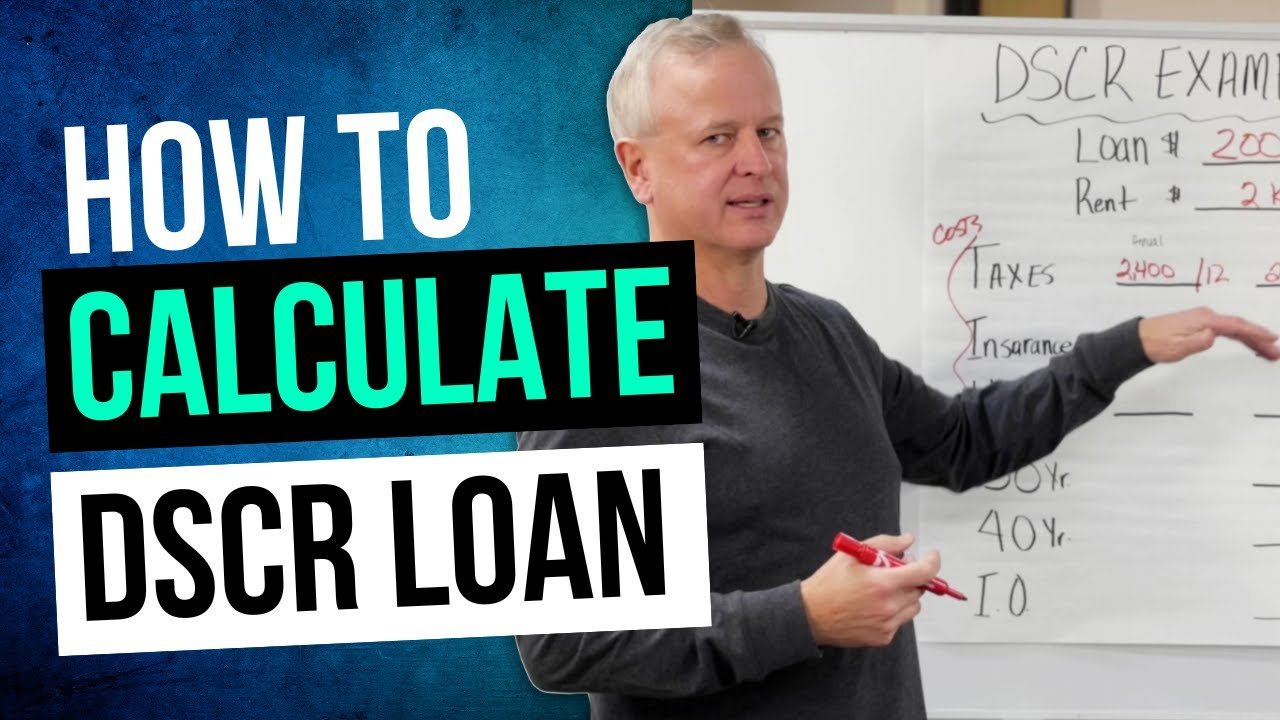
Most investors learn the DSCR formula in about ten seconds. Rent divided by expenses. Done.
Then they run their own deal, hand the number to a lender, and find out it’s wrong — because the lender counted things they left out, or discounted income they assumed would count in full.
This guide walks through the calculation the way an underwriter actually does it, with four worked examples and the three levers that move a weak ratio into approvable territory.
The DSCR Formula
DSCR = Monthly Rental Income ÷ Total Monthly Debt Obligations
That’s it. The complexity is never in the division. It’s in deciding what belongs in each half of the fraction.
What Counts as Income
For a property already rented, lenders typically use the lower of two figures:
- The actual rent on the signed lease
- The market rent estimate from the appraiser’s Form 1007
That “lower of” rule surprises people. If you’re renting to a family member below market, the lease governs. If you’ve pushed rent above what the appraiser thinks the market supports, the appraisal governs.
For a vacant property, or a purchase where you haven’t signed a tenant yet, the appraiser’s market rent estimate is used on its own.
Short-term rentals work differently. Lenders usually want twelve months of documented revenue — a Airbnb or VRBO earnings statement, or a property manager’s income report. Many then apply a discount to that figure, since nightly income is more volatile than a signed lease. We’ll show what that does to the math below.
What Counts as Expenses
The standard is PITIA:
- Principal
- Interest
- Taxes
- Insurance
- Association dues (HOA)
Notice what is not on that list: property management fees, maintenance, capital reserves, vacancy allowance, and utilities. Most lenders exclude these from the DSCR calculation entirely.
This creates an important gap. A property can hit a 1.25 DSCR on the lender’s math and still lose money in your bank account once you’ve paid the 8% management fee, fixed the water heater, and covered two vacant months. The lender’s DSCR is an underwriting screen, not a profitability analysis. Run both.
Example 1: Single-Family Rental
A three-bedroom rental leased at $3,000 per month.
| Principal & interest | $1,750 |
| Property taxes | $300 |
| Insurance | $120 |
| HOA | $30 |
| Total PITIA | $2,200 |
$3,000 ÷ $2,200 = DSCR 1.36
The property throws off 36% more income than its debt requires. This qualifies comfortably and would price well.
Example 2: Duplex
Two units, each leased at $1,650, for $3,300 in combined monthly rent.
| Principal & interest | $1,900 |
| Property taxes | $350 |
| Insurance | $150 |
| HOA | $0 |
| Total PITIA | $2,400 |
$3,300 ÷ $2,400 = DSCR 1.38
Small multi-family often calculates well because you’re spreading one set of fixed costs across two rent checks. It’s also why 2–4 unit properties appeal to investors who can’t make single-family numbers work in their market.
Example 3: Short-Term Rental (Where It Gets Tricky)
An Airbnb averaging $5,500 per month in gross revenue over the past twelve months.
| Principal & interest | $2,600 |
| Property taxes | $400 |
| Insurance | $250 |
| HOA | $100 |
| Total PITIA | $3,350 |
Run it on gross revenue and you get $5,500 ÷ $3,350 = 1.64. Excellent.
But suppose the lender applies a 20% haircut to short-term rental income to account for volatility. Now you’re working with $4,400.
$4,400 ÷ $3,350 = DSCR 1.31
Still approvable — but a full third of a point lower than the number you calculated at your kitchen table. This is the single most common surprise on short-term rental financing. Ask any lender, before you’re under contract, exactly how they treat STR income. The answer varies more than almost any other underwriting question.
Example 4: When the Number Doesn’t Work
A condo renting for $2,400 against $2,650 in PITIA.
$2,400 ÷ $2,650 = DSCR 0.91
The property doesn’t cover its own debt. You’d be writing a check every month to hold it.
Some lenders will still fund this, typically requiring a larger down payment and pricing the loan higher. That’s a legitimate option if you’re buying in a market where you have strong conviction on appreciation, or the property is genuinely underrented.
It’s a bad option if you’re stretching because you’re emotionally attached to the deal. A property with negative cash flow is a monthly liability. Appreciation has to materialize to save it, and appreciation is not a plan.
Three Levers That Move Your DSCR
Here’s where the math gets useful. Take one property: $3,000 monthly rent, a $500,000 purchase, 7.25% rate, and $450 per month in taxes, insurance, and HOA combined.
Lever 1: Increase the Down Payment
At 20% down, you borrow $400,000. On a 30-year amortizing loan, principal and interest come to $2,728.71.
$3,000 ÷ ($2,728.71 + $450) = DSCR 0.94 — declined.
Now put 30% down. You borrow $350,000, and P&I drops to $2,387.62.
$3,000 ÷ ($2,387.62 + $450) = DSCR 1.06 — approvable.
An extra $50,000 of equity moved the ratio by 0.12.
Lever 2: Extend the Term
Keep the $400,000 loan, but stretch it to 40 years. P&I falls to $2,558.69.
$3,000 ÷ ($2,558.69 + $450) = DSCR 1.00
Break-even, without another dollar down. The tradeoff is real, though: you’ll pay substantially more interest across the life of the loan, and you build equity more slowly.
Lever 3: Go Interest-Only
Same $400,000, but structured interest-only. The monthly payment becomes $2,416.67.
$3,000 ÷ ($2,416.67 + $450) = DSCR 1.05
The strongest ratio of the three, with no additional capital required. But you’re paying down no principal at all. Interest-only makes sense when you have a defined exit — a sale, a refinance, a value-add plan — and it becomes dangerous when it’s simply the only way the deal pencils.
Three structures, one property, three different answers. This is why the structure conversation should happen before you’re rushing to close, not during.
Common Mistakes
- Using gross rent for a short-term rental. Expect a haircut. Ask what it is.
- Forgetting HOA dues. A $300 monthly HOA can swing your DSCR by 0.10 or more.
- Using your estimated rent instead of the appraiser’s. Lenders take the lower of the two.
- Ignoring the tax reassessment. In many states, property taxes reset at purchase. Underwriting uses the new assessment, not the seller’s old tax bill. This catches investors constantly in California, Texas, and Florida.
- Confusing lender DSCR with actual cash flow. The formula excludes management, maintenance, capex, and vacancy. Your bank account does not.
Run Your Own Numbers
Before you make an offer, calculate the ratio yourself using conservative assumptions — the appraiser’s rent estimate rather than your optimistic one, and the reassessed tax figure rather than the seller’s.
Our DSCR calculator handles the arithmetic. If you’re still working out whether this loan type suits your situation, start with what a DSCR loan actually is.
When you’re ready to see real terms, apply now. Pre-qualification takes a few minutes and doesn’t involve a hard credit pull.
All figures above are illustrative. Rates, underwriting standards, income treatment, and expense inclusions vary by lender, property, and borrower. Nothing here constitutes a commitment to lend or financial, tax, or legal advice. Consult a qualified professional regarding your specific situation.